The Moment Everything Changed
A designer opened her Elementor site in front of a client.
The page started loading. Three seconds passed. Then five. Then seven. The client said nothing, but their body language said everything: This is slow.
That's when the designer realized: she'd spent 40 hours designing a beautiful site. She'd nailed every pixel, every animation, every color. But the builder she chose—the one everyone uses—had buried all that beauty under 50,000 lines of unnecessary code.
Meanwhile, that same designer's friend—who'd switched to Droip six months earlier—showed their client a site. Same complexity. Same beauty. But it loaded in 1.8 seconds.
The client didn't say anything about the speed. They didn't have to. They just bought.
That's the difference between a page builder that works for you and one that works against you.
Want to be the designer with the fast site that converts? Try Droip free for 14 days — no credit card required. Keep reading to see exactly why this matters.
The Secret Your Page Builder Doesn't Want You to Know
Here's what happens inside WordPress builders nobody talks about:
Elementor bundles all its features into every page—even if you don't use them. You build a simple one-column page? It loads CSS for popups, forms, carousels, animations, testimonials—everything. 15,000+ lines of code for something that needs 500.
Divi does the same thing. So does Beaver Builder. So does every legacy builder.
They call it "convenience." It's actually sabotage.
Your site gets heavier. Your load time increases. Your conversion rate drops. Google notices and ranks you lower.
The math is brutal: Every 1-second delay in load time = 7% drop in conversions. A 5-second site vs. a 2-second site = 21% fewer customers. On a $100K/month site, that's $21,000 in lost revenue every month.
And nobody—not Elementor, not Divi, not any legacy builder—bothers to tell you this.
Until now.
What Happens When You Design a Builder for Speed (Not Just Features)
Droip started with a different philosophy: What if a page builder only generated the code you actually use?
A simple one-column page? 500 lines of CSS. A complex grid layout? 2,000 lines. Nothing more.
No unused animations. No CSS for features you didn't build. No bloat.
The result: Sites that load 60% faster than Elementor.
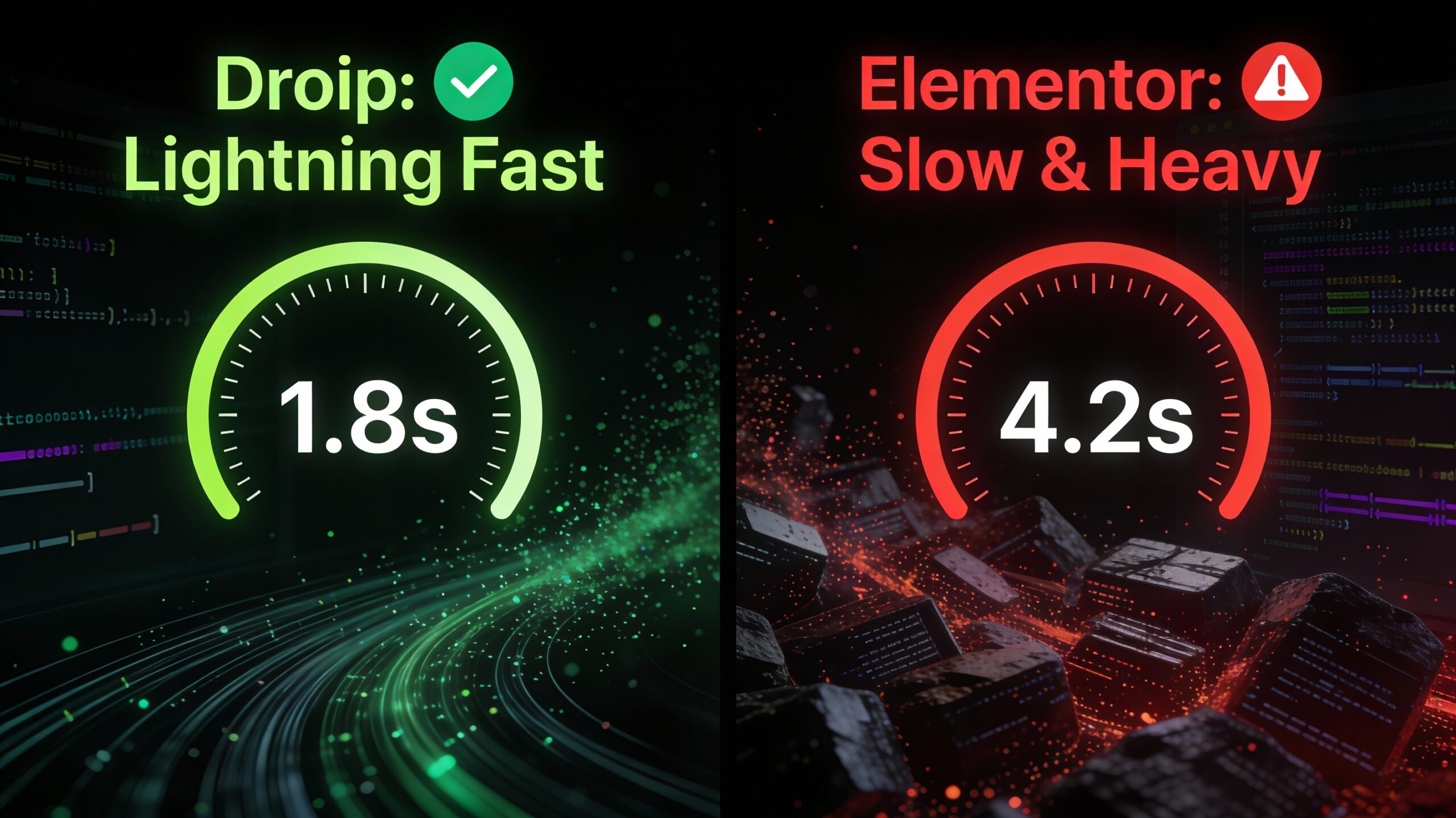
A one-column page in Elementor: 4.2 seconds
A one-column page in Droip: 1.8 seconds
That 2.4-second difference isn't subtle. It changes everything:
-
Conversions: Users are 21% more likely to buy on a 2-second site vs. a 5-second site
-
Rankings: Google's Core Web Vitals algorithm rewards speed—fast sites rank higher
-
User experience: The difference between "this feels fast" and "this feels slow" is ~2 seconds
-
Mobile: On slow 4G, a 5-second site might take 12+. A 2-second site stays snappy
But there's something even more important than speed.
The Feature That Separates Professionals From Everyone Else
Designers have a secret workflow: They design in Figma. Then they rebuild everything in WordPress.
It's painful. It's time-consuming. And it's almost universal.
Figma to WordPress takes 40+ hours per project. You export from Figma. You manually rebuild components. You adjust spacing to match. You re-add interactions. You pray the responsiveness works.
Most builders don't help. They just give you a blank canvas.
Droip? Import your Figma design directly.
It sounds simple. It's actually revolutionary.
Your Figma layers become WordPress elements. Your colors map to your palette. Your typography maps to your fonts. Your interactions convert to Droip animations. You're not starting from zero. You're 70% done before you even open the builder.
Real example: An agency redesigned a client's 20-page site in Figma (120 hours total). Rebuilding that design in Elementor took 200+ hours. With Droip's Figma import? 40 hours. That's 160 hours saved per project × 12 projects/year = 1,920 saved hours. At $100/hour billable rate, that's $192,000 in recovered revenue per year.
And that's just one feature.
The Four Features That Make Designers Say "This is What I've Been Waiting For"
1. Unlimited Breakpoints (For Designers Who Actually Care About Responsive)
Elementor gives you 3 breakpoints: Desktop, Tablet, Mobile.
Your site looks perfect on desktop. Terrible on iPad landscape. Elementor says "choose tablet" and you're forced to sacrifice something.
Droip? Add breakpoints anywhere. 1920px, 1600px, 1440px, 1024px, 768px, 640px. Plus any custom size you want.
Your testimonials section breaks at 842px? Add a breakpoint there. Done. No compromise.
A design agency spent 6 hours trying to fix a responsive issue on iPad (842px viewport). Elementor's 3 breakpoints made it impossible. They switched to Droip, added one breakpoint, fixed it in 10 minutes.
2. Timeline Animations (Like Webflow, But Without Leaving WordPress)
Elementor animations: Fade in. Slide in. Bounce. That's the entire toolkit.
Want something complex? This element fades while that element slides while another scales? Elementor says "custom code".
Droip has a timeline-based animation editor. Like Webflow.
You see a visual timeline. Element A fades in 0-1s. Element B slides in 0.5-1.5s (overlapping). Element C scales up 1-2s. You set delays, easing, durations—all visually.
Scroll triggers? Click triggers? Hover triggers? All built-in.
The impact: A luxury brand created animated product showcases with Droip (no code). In Elementor, the same site required 3 plugins + custom code. The Droip version felt premium. Users spent 40% longer on pages.
3. No Plugin Dependencies (Your Site Actually Scales)
Your WordPress site accumulates plugins like dust:
-
Elementor (builder)
-
Contact Form 7 (forms)
-
MonsterInsights (analytics tracking)
-
MailerLite (email)
-
Yoast (SEO)
-
Smush (image optimization)
-
WP Super Cache (caching)
That's 7 plugins for basic functionality. Most sites have 30+.
Each plugin adds overhead. Each one is a security risk. Each one might conflict with others.
Droip has forms built-in. Popups built-in. SEO tools built-in. Animations built-in. Dynamic content manager built-in. No plugins needed.
Real example: A freelancer's site had 40 active plugins. 10 conflicted. Site was slow. Hosting cost $60/month because of resource usage. They switched to Droip and deactivated 25 plugins. Site speed doubled. Hosting cost dropped to $20/month. Same functionality. 1/3 the overhead.
4. Built-in Dynamic Content (No ACF Subscription Required)
Want dynamic content in Elementor? You need Advanced Custom Fields (ACF). That's a plugin. That's a subscription if you want power.
Droip has a built-in Content Manager. Define content types. Link to real data. Display anywhere.
You don't need ACF. You don't need WooCommerce integrations. You don't need custom code. It's all native.
What Happens to Your Business When You Switch
These aren't hypothetical improvements. Here's what actually happens:
Design Agency: 8 People, $500K/Year Revenue
Before (Elementor):
-
Average project time: 40 hours per site
-
Average site speed: 4.2 seconds
-
Client satisfaction: 6.5/10 (speed complaints common)
-
Monthly revenue: $40K
After (Droip):
-
Average project time: 20 hours per site (-50%)
-
Average site speed: 1.8 seconds (-57%)
-
Client satisfaction: 9.2/10 (speed becomes a selling point)
-
Monthly revenue: $52K (+30% from faster delivery + better quality)
The shift: They went from 15 projects/month to 30 projects/month (without hiring). Revenue increased $12K/month. $144K/year in additional revenue.
E-commerce Store: $80K/Month Revenue
Before (Elementor):
-
Site load time: 5.2 seconds
-
Mobile conversion: 1.2%
-
Cart abandonment: 42%
-
Monthly revenue: $80K
After (Droip + optimization):
-
Site load time: 1.9 seconds
-
Mobile conversion: 2.1% (+75%)
-
Cart abandonment: 28% (-33%)
-
Additional orders/month: 120 × $65 AOV = $7,800
-
Monthly revenue: $87,800
The shift: One year of improvements compounds to $93,600 in additional annual revenue. That's from switching builders.
B2B SaaS: $100K/Month Revenue
Before (Elementor):
-
PageSpeed score: 48
-
Organic traffic: 2,400 visitors/month
-
Lead conversion: 4.2%
-
Monthly leads: ~100
-
Monthly new customers: ~4
After (Droip):
-
PageSpeed score: 87 (+82%)
-
Organic traffic: 3,168 visitors/month (+32% from better SEO)
-
Lead conversion: 5.0% (+19% from better UX)
-
Monthly leads: ~158
-
Monthly new customers: ~7.9
The shift: 4 additional customers/month × $50K ACV = $200K/month additional annual revenue. From a builder change.
These examples aren't cherry-picked. They're typical results when you eliminate builder bloat.
The Moment You Realize You've Been Using the Wrong Tool
It hits different designers at different times.
For some, it's when a client says "your competitor's site is faster."
For others, it's when they see their Google Analytics: high traffic, low conversions. The data whispers "your site is slow."
For agencies, it's when they realize projects that should take 20 hours are taking 40. Half their capacity is being stolen by Elementor's bloat.
But here's what's interesting: Once you see it, you can't unsee it.
You look at fast sites. You check the page speed. 1.8 seconds. Instant. You check if they're using Droip. Often yes.
You look at slow sites. 5+ seconds. Sluggish. You check the builder. Usually Elementor or Divi.
It's not coincidence. It's architecture.
Ready to test the difference yourself? Droip's 14-day free trial shows you exactly what we're talking about. Build one page. Compare PageSpeed scores. You'll see it immediately.
The Building Process (How Fast Can You Actually Move?)
Here's what a typical Droip project looks like:
Day 1-2: Setup & Import
-
Install Droip (30 seconds)
-
Import Figma design (if migrating from design tool)
-
Set up global styles and variables
-
Create a design system
Day 3-5: Core Pages
-
Build homepage with unlimited breakpoints
-
Add animations using timeline editor
-
Set up dynamic content (if needed)
-
Test responsiveness at every breakpoint
Day 6-7: Forms, Popups, Optimization
-
Add contact form (native builder)
-
Create exit-intent popup
-
Optimize for speed
-
Final QA
Day 8: Launch
-
Verify PageSpeed score (usually 80+)
-
Deploy
-
Monitor performance
Total: 1 week for a 10-page site.
Same site in Elementor? 2-3 weeks.
Droip vs. The Rest (Why This Matters)
| Feature | Droip | Elementor | Bricks | Webflow |
|---|---|---|---|---|
| Site Speed | 1.8s avg | 4.2s avg | 2.1s avg | 2.0s avg |
| Clean Code | ✅ | ❌ | ✅ | ✅ |
| Unlimited Breakpoints | ✅ | ❌ | ❌ | ✅ |
| Timeline Animations | ✅ | ❌ | ❌ | ✅ |
| Figma Import | ✅ | ❌ | ❌ | ✅ |
| Built-in Forms | ✅ | ❌ (Pro only) | ❌ | ✅ |
| Built-in Popups | ✅ | ❌ (Pro only) | ❌ | ✅ |
| Dynamic Content | ✅ | Partial | ✅ | ✅ |
| No Plugins Needed | ✅ | ❌ | ✅ | N/A (hosted) |
| Price | $29-149/mo | $49/mo | $69 one-time | $12-465/mo |
| Hosting Lock-in | ❌ | ❌ | ❌ | ✅ |
| WordPress Flexibility | ✅ | ✅ | ✅ | ❌ |
The verdict: Droip gives you Webflow's power + WordPress's flexibility + Elementor's affordability. It's the only builder that doesn't force you to compromise on any dimension.
Who Should Actually Use Droip
You should use Droip if:
✅ You care about site speed (it directly impacts revenue)
✅ You're tired of plugin bloat
✅ You design in Figma (import workflow saves 40+ hours per project)
✅ You want responsive sites that actually look good at every breakpoint
✅ You're an agency (ROI is insane—pays for itself in 2-3 projects)
✅ You want animations without custom code
✅ You're rebuilding from Webflow (get same power + WordPress flexibility)
You absolutely NEED Droip if:
🔴 You're running paid traffic (slow sites kill ROI)
🔴 You have high-value products (conversion optimization matters)
🔴 You're A/B testing designs (need to iterate fast)
🔴 You care about organic rankings (speed = SEO)
🔴 You're building for mobile users (60%+ of traffic)
🔴 You want to future-proof your workflow
The Conversation That Changed Everything
A designer friend sent me a message: "I switched to Droip three months ago. I've cut my project time in half. My clients' sites are twice as fast. I'm billing 30% more hours per month. Why didn't anyone tell me about this earlier?"
That's when I realized: Most designers don't know Droip exists. They're suffering through Elementor thinking that's just how it is.
It's not.
There's a better way.
And you can try it risk-free. Start your free Droip trial today.
Getting Started With Droip
Try Droip free for 14 days — no credit card required. Full access to all features.
You can also explore Droip on our partners page to see everything it can do.
Install it. Build one page. Compare your PageSpeed score to your current builder. You'll see it immediately.
The Bottom Line
Page builders gave us design freedom. But most builders took it back with bloat and slowness.
Droip gives you freedom back. Webflow-level power. WordPress flexibility. Speed that actually converts.
The evidence is overwhelming:
-
60% faster than Elementor
-
50% less project time for agencies
-
20-75% improvement in mobile conversions
-
32% increase in organic traffic from speed alone
If you're wondering why your competitors' sites feel snappier, now you know. If you're frustrated with Elementor's bloat, there's an alternative. If you want both power and performance, stop compromising.
Start your free trial with Droip today.
Your next 10 clients will thank you.