Introduction: The Referral Economy Is Here
Dropbox grew from zero to 4 million users in 15 months using one mechanic: free storage space for referrals. Harry's had 100,000 interested customers before launch with a pre-launch viral loop. Revolut scaled 150x through referrals.
These aren't outliers. They're the new baseline.
In 2026, the economics of customer acquisition have fundamentally shifted. Paid advertising costs continue climbing. Organic reach on social platforms continues shrinking. Meanwhile, the fastest-growing companies are no longer fighting harder for attention—they're building systems that make customers want to promote them.
This is where viral referral marketing becomes non-negotiable.
But here's the uncomfortable truth: most referral campaigns fail because they're built on the wrong mechanics.
A poorly designed referral campaign might add 50 leads. A well-designed one that uses the right mechanics? It could add 43,870 leads in 90 days (as Marloes Collins experienced).
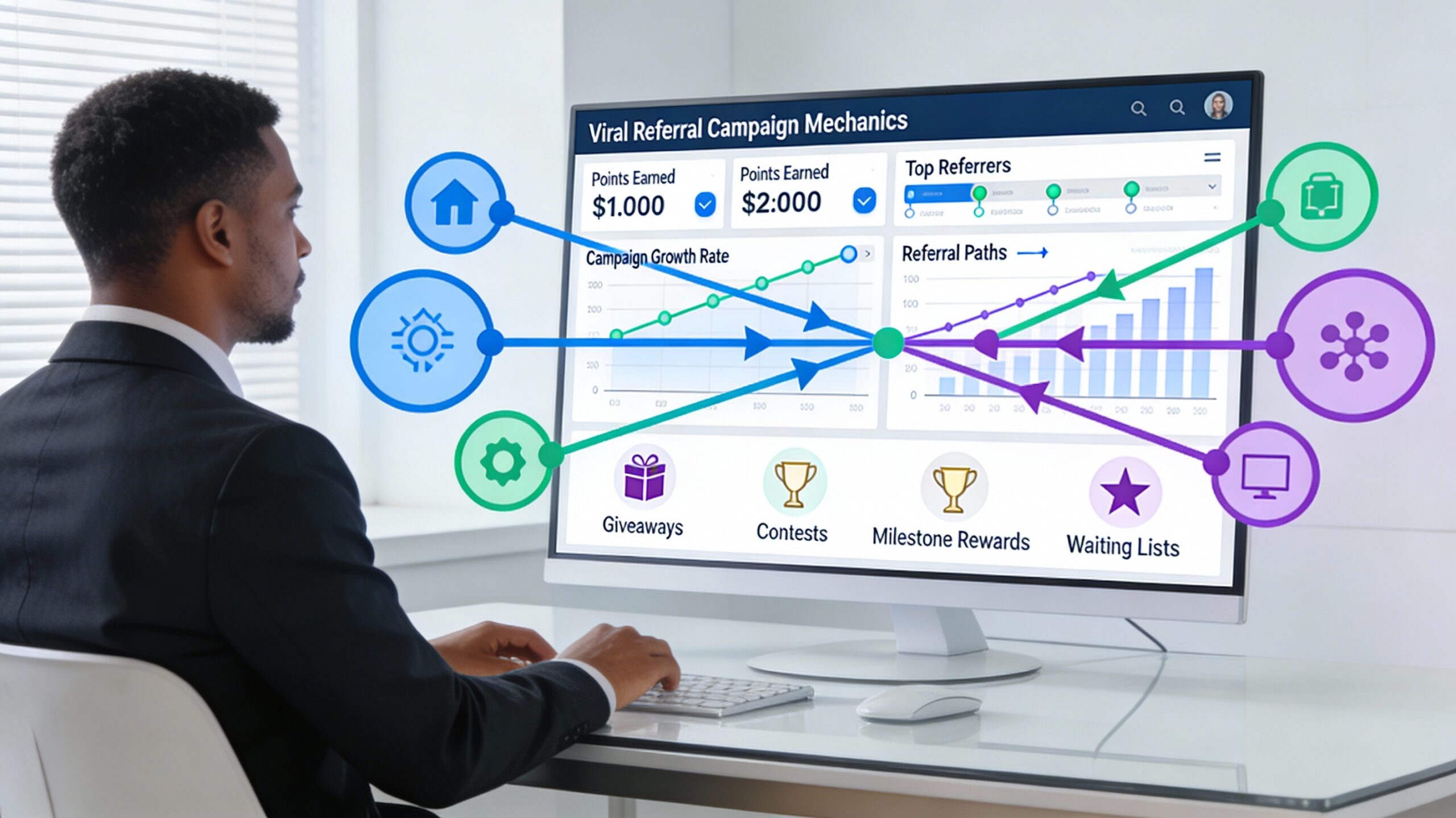
The difference isn't luck. It's understanding which of the 7 viral mechanics works for your specific business.
Part 1: The 7 Viral Mechanics That Drive Exponential Growth
Not all referral campaigns are created equal. The mechanic you choose determines whether your campaign compounds exponentially or flatlines.
Mechanic 1: The Point-Based Giveaway (Best for Lead Volume)
How it works:
Participants earn points for actions like referring a friend (10 points), sharing on social media (5 points), following on Instagram (3 points). The more points they accumulate, the more entries they get into a grand prize drawing.
Why it works:
Creates immediate feedback loop (users see points increment in real-time)
Encourages repeat actions (users want to hit next milestone)
Gamification increases engagement (leaderboards show who's winning)
Works across industries
Best for: E-commerce, email list building, social media growth
Real example: Michael Winter ran an UpViral trial for $1 and added 3,100+ subscribers in 14 days.
Mechanic 2: The Multi-Tier Milestone Reward (Best for Customer Loyalty)
How it works:
Users unlock rewards immediately upon reaching milestones: Refer 1 friend → 15% discount. Refer 3 friends → free product. Refer 5 friends → high-value product. This creates a ladder effect.
Why it works:
Immediate gratification (not waiting for a drawing)
Creates stickiness (users come back for next tier)
Builds loyalty (referred customers often spend more)
Self-reinforcing cycle
Best for: SaaS, subscription services, fitness studios, salons
Real example: Viralify case study—A salon used tiered rewards:
Refer 1 customer → 20% discount
Refer 3 customers → Free manicure
Refer 5 customers → Enter for $200 gift card
Result: 40% increase in bookings, 400+ new customers in 5 months.
Mechanic 3: The Sweepstake/Contest Model (Best for Social Media Growth)
How it works:
Users enter a contest to win a big prize. To increase odds of winning, they share the contest on social media or invite friends. Each action = one additional entry.
Why it works:
Prize creates urgency
Social sharing spreads organically
Low barrier to entry
Viral loop potential
Best for: Social media follower growth, brand awareness
Real example: Fitness studio sweepstake—Win free membership, 5 referrals = personal training, 10 referrals = $500 prize. Result: 35% membership increase, 300+ new members in 3 months.
Mechanic 4: The Waiting List With Urgency (Best for Pre-Launch)
How it works:
You have a coming launch (product, course, membership). Early signups get locked-in pricing or exclusive bonuses. People jump ahead on the list by referring friends.
Why it works:
FOMO drives signups
Urgency compounds referrals
Pre-launch hype builds momentum
Warm audience at launch (pre-qualified)
Best for: Product launches, course launches, SaaS launches
Real example: Harry's used pre-launch waiting lists + referrals to build 100,000+ interested customers before day one.
Mechanic 5: The Dual-Sided Incentive (Best for Network Effects)
How it works:
Incentivize BOTH referrer AND referred person. Referrer gets $20 credit. New customer gets $20 credit. Both win.
Why it works:
Removes friction for the referred person
Creates reciprocity (they feel invested)
Builds network faster
Increases customer lifetime value
Best for: Marketplace platforms, delivery apps, financial services
Real example: Dropbox's program—Referrer gets 500MB free storage, new user gets 500MB. This simple mechanic created 4,000% growth in 15 months.
Mechanic 6: The Behavior-Triggered Campaign (Best for Engagement)
How it works:
Instead of one-time campaigns, set evergreen campaigns triggered by behaviors: New customer joins → email with referral link. Customer makes second purchase → referral incentive. Customer reaches 90-day mark → special offer.
Why it works:
Constant stream of referral invitations
Behavior-based timing (ask when they're most engaged)
Compound effect (run 10+ campaigns simultaneously)
Low cost to maintain (fully automated)
Best for: Subscription services, SaaS, loyalty programs
Real example: User reports on UpViral: "99% of the viral process is fully automated. Saves us a ton of time".
Mechanic 7: The Exclusive Community Model (Best for High-LTV Customers)
How it works:
Create exclusive community or membership. To maintain status or unlock higher tiers, members must refer customers. Referrals become the entry fee.
Why it works:
Creates exclusivity (members feel special)
Sustainable growth loop (members keep referring to stay in)
Self-filtering (only engaged users stay)
High LTV (maintaining members have highest lifetime value)
Best for: Premium memberships, exclusive communities, coaching
Ready to Build Your First Campaign?
Now that you understand the 7 mechanics, it's time to actually build one.
UpViral is purpose-built for this exact job. It handles the technical complexity so you can focus on strategy and mechanics.
Here's what separates UpViral from generic giveaway tools:
Point-Based System
Unlike generic giveaway tools, UpViral's point system lets you incentivize multiple actions. This is crucial—it's what drives high viral coefficients.
Pre-Built Templates
Start from templates for contests, sweepstakes, waiting lists, milestone rewards. No design skills needed.
Smart Leaderboards
Gamification works. Leaderboards show who's winning in real-time, creating urgency.
Behavioral Triggers
Set up evergreen campaigns that trigger based on user actions. Run ongoing referral programs, not just one-off contests.
Social Integration
Easy Facebook, Instagram, TikTok, email sharing. One-click sharing increases referral rates by 60%+.
Email Notifications
Automated follow-ups remind people to share. Built-in email sequences do the work for you.
Referral Tracking
See exactly where each lead came from. Understand your viral coefficient. Optimize accordingly.
14-Day Trial for $1
Test everything before committing to a full plan.
Ready to test it? Start your 14-day trial with UpViral.
Part 2: The Campaign Architecture Framework
Knowing the 7 mechanics is step one. Building a campaign that works requires understanding these 5 essential components:
Component 1: The Hook
What gets attention? Compelling prizes, exclusive access, significant discounts, status/exclusivity.
Component 2: The Friction Gradient
Ideal: 1-2 steps maximum. Each extra step loses 30% of participants.
Component 3: The Incentive Stack
Offer multiple ways to earn—Action 1 = 5 points, Action 2 = 10 points, Action 3 = 20 points. Stack so everyone has a path.
Component 4: The Viral Coefficient
Viral coefficient < 1 = dies out. VC = 1.0 = linear growth. VC > 1.2 = exponential growth.
To achieve high viral coefficient:
Make sharing easy (one-click buttons)
Make links personalized
Incentivize the sharer
Create multiple share channels
Component 5: The Follow-Up Sequence
Getting someone in is step one. Converting them is step two. Set up automated emails at Day 0, Day 5, Day 10, and Day 14.
Part 3: Campaign Templates by Business Type
E-Commerce & Physical Products
Best mechanics: Point-based giveaway + dual-sided incentive
Template:
"Refer 1 friend and earn $10 credit"
"Your friend gets $10 credit too"
Grand prize: $500 product bundle for leaderboard winners
Why: E-commerce customers love free money. Both sides winning removes friction.
SaaS & Subscriptions
Best mechanics: Milestone rewards + behavior-triggered campaigns
Template:
Refer 1 = 1 month free
Refer 3 = 3 months free
Refer 5 = Free lifetime premium support
Triggered at: signup (day 1), day 30, day 90, day 180
Why: SaaS has natural cohort structure. Triggering at milestones maximizes conversion.
Email List Building & Lead Magnets
Best mechanics: Point-based giveaway + waiting list
Template:
Download free guide = entry into $1,000 sweepstake
Refer 3 friends = 5 extra entries
Share on social = 3 extra entries
Refer via email = 2 extra entries
Why: Volume wins. Points + multiple action types maximizes participation.
Course & Product Launches
Best mechanics: Waiting list + tiered milestone rewards
Template:
First 100 to refer 5 people = $500 off at launch
Next 200 to refer 3 people = $200 off at launch
Everyone else = 30% off at launch
Why: Creates urgency + incentivizes early movers + guarantees baseline discount.
Social Media Growth
Best mechanics: Sweepstake/contest + multi-channel sharing
Template:
Follow us on Instagram = 1 entry
Share post on Instagram = 3 entries
Tag a friend = 2 entries
Join newsletter = 5 entries
Grand prize: $1,000 gift card
Why: Multiple action types drive different demographics.
Fitness Studios, Salons, Service Businesses
Best mechanics: Tiered milestone rewards + behavior triggers
Template:
Refer 1 = Free session ($75 value)
Refer 3 = $150 store credit
Refer 5 = $300 store credit + VIP status
Triggered quarterly (recurring program)
Why: High margins + long customer LTV. Milestone model drives loyalty + repeat.
Part 4: The Setup & Implementation Guide
Step 1: Choose Your Mechanic & Hook (Week 1)
Ask yourself:
What's my business model?
What's my customer lifetime value? (affects incentive budget)
What do I want to optimize for?
What action do I want to incentivize most?
Then pick from the 7 mechanics.
Step 2: Design Your Incentive Stack (Week 1)
Create your reward matrix showing what actions earn what points/value. Ensure:
Every action has a point value
Values are proportional to effort
Total budget is sustainable
Mix of easy (2-3 points) and hard actions (10+ points)
Step 3: Set Up Campaign Mechanics (Week 2)
Using UpViral:
Choose campaign type (giveaway, sweepstake, milestone, etc.)
Set up landing page
Create point system
Configure rewards
Set up email notifications
Enable social sharing
Add A/B testing
Step 4: Create Your Follow-Up Email Sequence (Week 2)
Email 1 (Day 0): Welcome + Instructions
Email 2 (Day 5): Momentum + Urgency (show leaderboard)
Email 3 (Day 10): Last Call (countdown)
Email 4 (Day 14): Winner Announcement + special offer
Step 5: Set Your Campaign Duration (Week 2)
Short (7-14 days): Create urgency, drive concentrated volume
Medium (30 days): Sustainable growth, let people spread naturally
Long (60+ days): Build compound effect, multiple waves
Evergreen: Run continuously, refresh quarterly
For first-time campaigns, 30 days is ideal.
Step 6: Launch & Optimize (Week 3+)
Launch to your audience:
Email your list
Post on social
Tell your team
Reach out to VIP customers
Then monitor:
Signup conversion rate
What actions people take
Viral coefficient (above 1.0?)
Cost per acquisition
Which channels drive conversions
If viral coefficient < 1.0 after week 1, adjust:
Make prize more compelling
Reduce sharing friction
Send more follow-up emails
Test different mechanic
Part 5: Real Campaign Results (Proof)
Nathan Chan - Email List (3,000+ subscribers)
Campaign: Point-based giveaway
Duration: 14 days
Results: 3,000+ hyper-targeted subscribers
Lesson: High-quality incentives attract engaged audiences
Marloes Collins - Explosive Growth (43,870 leads)
Campaign: Multi-phase referral campaign
Duration: Extended
Results: 43,870 leads + 135,554 visitors
Lesson: Multi-phase campaigns compound. Week 1 brings 1,000. Week 4 brings 10,000.
Michael Winter - Rapid Acquisition (3,100+ subscribers)
Campaign: Point-based giveaway
Duration: 14 days
Spend: $1 trial
Results: 3,100+ subscribers in 14 days
Lesson: Right mechanic drives exponential growth even with minimal spend
Viralify Salon - Service Industry (400+ customers)
Campaign: Tiered milestone rewards
Duration: 5 months (ongoing)
Results: 40% booking increase, 400+ new customers, 30% satisfaction boost, 70% engagement boost
Lesson: Service businesses win with milestone models.
Viralify Fitness Studio (300+ new members)
Campaign: Multi-tier sweepstake
Duration: 3 months
Results: 35% membership increase, 300+ members, 20% retention boost, 40% engagement
Lesson: Gyms win when fitness is social.
Part 6: Common Mistakes (And How to Avoid Them)
Mistake 1: Generic Prize
Wrong: "$100 gift card"
Right: "All-expenses-paid weekend in Bali"
Generic prizes don't motivate. Specific, experiential prizes do.
Mistake 2: Too Many Barriers
Wrong: Sign up → verify → survey → password → confirm phone
Right: Click → email → done
Each barrier loses 30%.
Mistake 3: Weak Viral Coefficient
Wrong: VC = 0.7 (dies out)
Right: VC = 1.3+ (exponential)
To increase: one-click sharing, incentivize shares, multiple channels, personalized links.
Mistake 4: No Follow-Up
Wrong: Set campaign, hope people share
Right: Email every 3-5 days
Reminders increase sharing 40-60%.
Mistake 5: Wrong Mechanic
Wrong: E-commerce using waiting list (no urgency)
Right: E-commerce using point-based giveaway (incentivizes action)
Match mechanics to business type.
Mistake 6: Incentive Budget Too Low
Wrong: "Earn $2"
Right: "Earn $20"
Budget at least 10-15% of customer LTV for referral incentives.
Mistake 7: Campaign Duration Wrong
Wrong: 90 days (people forget) or 3 days (not enough time)
Right: 30 days (urgency + compounding)
Getting Started With UpViral
Ready to launch your first viral campaign?
Explore UpViral on our partners page to see all features and understand how it fits your marketing strategy.
When you're ready to build your first campaign, start your campaign here with UpViral's platform. Your 14-day $1 trial gives you unlimited access.
Next Steps: Beyond Viral Campaigns
Viral referral marketing is one piece of your growth puzzle. You also need:
Lead nurturing tools → Convert campaign participants to customers
Email marketing platform → Follow up with growing list
Analytics & tracking → Understand what's working
Content marketing → Attract people to campaigns
Explore the complete toolkit on saaspartout.com/marketplace. You'll find tools for every stage of customer acquisition, conversion, and retention.
Not sure which tools fit your strategy? Use our AI Assistant to map your entire marketing stack.
The Bottom Line
Viral referral campaigns aren't luck. They're systems.
The 7 mechanics work. The proof is in Dropbox's 4,000% growth, Harry's 100K pre-launch, Nathan Chan's 3,000 subscribers, and Marloes Collins' 43,870 leads.
The question isn't whether referral marketing works. It's whether you're using the right mechanic for your business.
If you're paying $40-$60 per lead on ads while competitors acquire at $8-$15 through referrals, it's time to build a viral campaign.
Start your first campaign with UpViral today. Your 14-day $1 trial lets you test every mechanic, every template, every feature.
The fastest-growing businesses in 2026 aren't outspending on ads. They're outsmarting with mechanics.